
Medicare

Medicare is a federal health insurance program primarily for people age 65 and older.   It is also available to some people under 65 with certain disabilities or qualifying conditions. Understanding the basics can help you make more informed decisions about your coverage.

How Do I Get Medicare?

Medicare is health insurance for people 65 or older who meet citizenship or residency requirements. You may be eligible to get Medicare earlier if you have a disability, End-Stage Renal Disease (ESRD), or ALS (also called Lou Gehrig’s disease).


Senior man watering a houseplant at home, enjoying an active retirement

Some people are automatically enrolled in Medicare Parts A and B, while others need to sign up. When and how you enroll depends on your circumstances, including whether you’re receiving Social Security benefits or have coverage through current employment.

When Can I Enroll?

Medicare has specific enrollment periods. For many people, the first opportunity to enroll begins three months before their 65th birthday and continues for seven months. Other enrollment opportunities may apply depending on your circumstances, including current employer coverage.

Diana smiling with a group of senior clients gathered warmly around a table

After you have chosen a Medicare plan, you may switch plans during the Annual Enrollment Period, between October 15th to December 7th. The plan that you choose will be effective on
January 01, the following year.

Nurse checking in on a smiling patient in a hospital bed, representing Medicare Part A inpatient hospital coverage

PART A
Hospital Coverage


Helps cover inpatient hospital care, skilled nursing facility care, hospice care, and some home health care.
Most people don’t pay a monthly premium for Part A if they or their spouse paid Medicare taxes for at least 10 years while working.

Doctor consulting with a senior patient in a medical office, representing Medicare Part B outpatient care

PART B
Medical Coverage


Helps cover doctors’ services, other health care providers’ services, outpatient care, home health care, durable medical equipment, and many preventive services. 
Most people pay a monthly premium for Part B. The amount can vary depending on income.
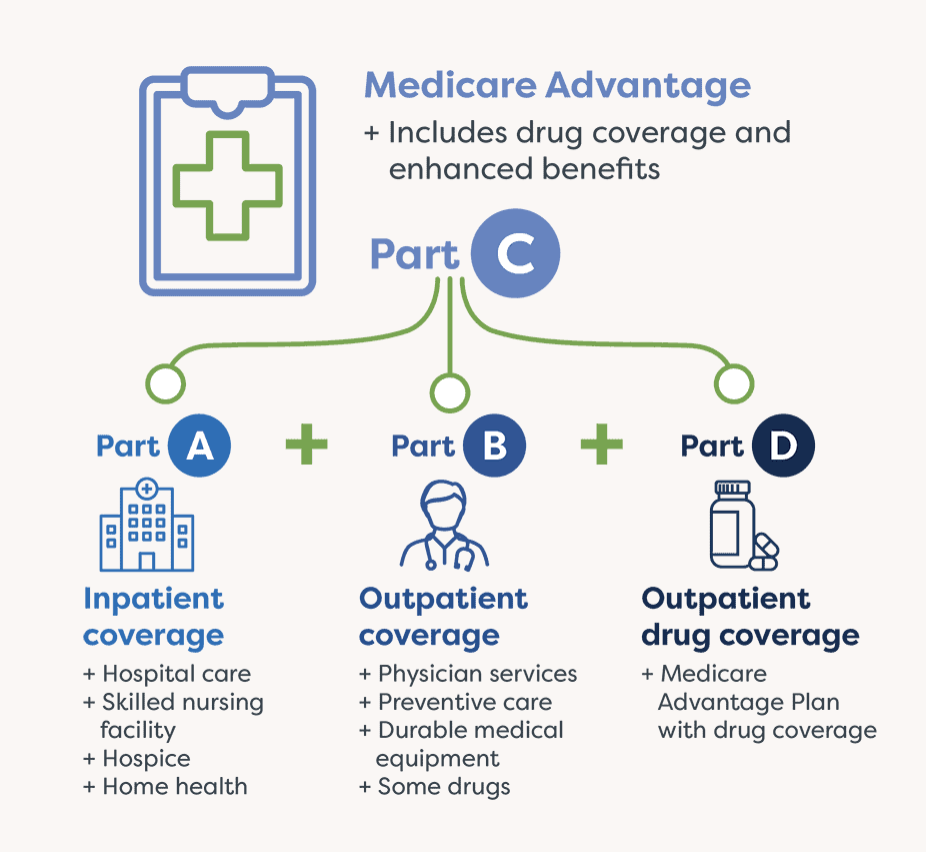
Diagram of Medicare Part C (Medicare Advantage), showing how it bundles Part A inpatient, Part B outpatient, and Part D drug coverage

Diagram of Medicare Part C (Medicare Advantage), showing how it bundles Part A inpatient, Part B outpatient, and Part D drug coverage

PART C
Medicare Advantage


Bundles your Part A and B coverage into one plan, offered by a private insurance company approved by Medicare.

Most Part C plans also include prescription drug coverage plus extra benefits like dental, vision, or hearing.

Three prescription medication bottles, representing Medicare Part D prescription drug coverage

PART D
Prescription Drugs


Helps cover the cost of prescription drugs, including many recommended vaccines and shots.
It’s offered by private insurance companies and can be added to original Medicare and supplemental plans, or may already be built into your Part C AKA Medicare Advantage plan.

Medicare, Made Clear

Get clear, personal Medicare guidance from Diana, a licensed independent insurance broker.

Required Disclaimer: “I do not offer every plan available in your area. Any information I provide, is limited to those plans I am contracted with in your area.  Please contact Medicare.gov or 1-800-MEDICARE to get information on all of your options”.

Licensed Insurance Broker in: CA, AZ, NV, OR, TX